AI-Assisted Architecture Migration

AI-Assisted Architecture Migration for CleanTech Platform
AI-Assisted Architecture Migration for CleanTech Platform
AI-Assisted Architecture Migration for CleanTech Platform
AI-assisted engineering helped modernize a complex micro-frontend platform, reducing migration time from four weeks to one. Automated dependency monitoring also improved long-term stability across six repositories.
AI-assisted engineering helped modernize a complex micro-frontend platform, reducing migration time from four weeks to one. Automated dependency monitoring also improved long-term stability across six repositories.
AI-assisted engineering helped modernize a complex micro-frontend platform, reducing migration time from four weeks to one. Automated dependency monitoring also improved long-term stability across six repositories.
AI
Renewable Energy
SaaS
AI-Assisted Architecture Migration
AI-Assisted Architecture Migration
Client overview
Client overview
Client overview
Our client is a European CleanTech platform operating in the renewable energy industry. Their product is a certificate management and transfer platform, backed by a parent company that handles cross-border certificate brokering between countries and large energy consumers. Client’s platform simplifies the acquisition, tracking, and verification of certificates – proving that a company consumed a given amount of energy from renewable sources within a reporting period.
Our client is a European CleanTech platform operating in the renewable energy industry. Their product is a certificate management and transfer platform, backed by a parent company that handles cross-border certificate brokering between countries and large energy consumers. Client’s platform simplifies the acquisition, tracking, and verification of certificates – proving that a company consumed a given amount of energy from renewable sources within a reporting period.
Our client is a European CleanTech platform operating in the renewable energy industry. Their product is a certificate management and transfer platform, backed by a parent company that handles cross-border certificate brokering between countries and large energy consumers. Client’s platform simplifies the acquisition, tracking, and verification of certificates – proving that a company consumed a given amount of energy from renewable sources within a reporting period.
Industry context
Industry context
Industry context
The renewable energy certificates market is growing fast but operating slowly.
The renewable energy certificates market is growing fast but operating slowly.
As ESG reporting requirements tighten across Europe and North America, companies are under increasing pressure to prove their energy consumption comes from renewable sources. That proof takes the form of certificates – Guarantees of Origin in Europe, RECs in the US. The certificates issued by government registries and transferred between parties through a patchwork of country-specific processes.
The problem is that most of this still runs on bureaucracy. Each country has its own registry, its own rules, and its own integration requirements. Large energy consumers can negotiate directly with governments. Smaller companies need intermediaries. And the platforms connecting buyers, sellers, and registries are often built on aging infrastructure that wasn’t designed for the volume or complexity the market now demands.
As ESG reporting requirements tighten across Europe and North America, companies are under increasing pressure to prove their energy consumption comes from renewable sources. That proof takes the form of certificates – Guarantees of Origin in Europe, RECs in the US. The certificates issued by government registries and transferred between parties through a patchwork of country-specific processes.
The problem is that most of this still runs on bureaucracy. Each country has its own registry, its own rules, and its own integration requirements. Large energy consumers can negotiate directly with governments. Smaller companies need intermediaries. And the platforms connecting buyers, sellers, and registries are often built on aging infrastructure that wasn’t designed for the volume or complexity the market now demands.
As ESG reporting requirements tighten across Europe and North America, companies are under increasing pressure to prove their energy consumption comes from renewable sources. That proof takes the form of certificates – Guarantees of Origin in Europe, RECs in the US. The certificates issued by government registries and transferred between parties through a patchwork of country-specific processes.
The problem is that most of this still runs on bureaucracy. Each country has its own registry, its own rules, and its own integration requirements. Large energy consumers can negotiate directly with governments. Smaller companies need intermediaries. And the platforms connecting buyers, sellers, and registries are often built on aging infrastructure that wasn’t designed for the volume or complexity the market now demands.
For platform companies like our client, this creates a dual challenge: you’re building against a moving regulatory target while your own codebase is accumulating technical debt from rapid feature development. The teams that can modernize their infrastructure fastest, without disrupting live operations, have a real competitive advantage.
For platform companies like our client, this creates a dual challenge: you’re building against a moving regulatory target while your own codebase is accumulating technical debt from rapid feature development. The teams that can modernize their infrastructure fastest, without disrupting live operations, have a real competitive advantage.
Challenge
Challenge
Challenge
When one of Brightgrove’s front-end engineer joined the project, they found that the platform had reached a roadblock: progress had slowed, and the team lacked alignment on the core problems and the best path forward.
The frontend had been split into micro frontends about a year earlier. On paper, this was supposed to let teams work independently across domain areas, in reality, it created more problems than it solved:
• Tight cross-dependencies: The micro frontends shared so many libraries that updating one frequently broke another.
• No version of sync tooling: When a shared library was updated in the shell app, each micro frontend had to be manually aligned. Mismatches only surfaced at runtime – in production.
• Outdated bundler: Everything was running on WebPack, cobbled together without a consistent build configuration across repos.
• No clear product direction: The platform kept pivoting toward whichever government registry opened next without a stable roadmap.
• Low test coverage: ~35% unit test coverage, no integration tests across microfrontends. The frontend quality was significantly behind the backend.
Adopting a micro-frontend architecture is a major structural shift, and the team quickly hit a common scaling bottleneck: build maintenance and dependency bugs began eating up engineering hours meant for feature development. To resolve this friction, the path forward required a dual approach: upgrading the codebase to a modern build tool (Rsbuild) and establishing an automated, structural fix for ongoing dependency management.
When one of Brightgrove’s front-end engineer joined the project, they found that the platform had reached a roadblock: progress had slowed, and the team lacked alignment on the core problems and the best path forward.
The frontend had been split into micro frontends about a year earlier. On paper, this was supposed to let teams work independently across domain areas, in reality, it created more problems than it solved:
• Tight cross-dependencies: The micro frontends shared so many libraries that updating one frequently broke another.
• No version of sync tooling: When a shared library was updated in the shell app, each micro frontend had to be manually aligned. Mismatches only surfaced at runtime – in production.
• Outdated bundler: Everything was running on WebPack, cobbled together without a consistent build configuration across repos.
• No clear product direction: The platform kept pivoting toward whichever government registry opened next without a stable roadmap.
• Low test coverage: ~35% unit test coverage, no integration tests across microfrontends. The frontend quality was significantly behind the backend.
Adopting a micro-frontend architecture is a major structural shift, and the team quickly hit a common scaling bottleneck: build maintenance and dependency bugs began eating up engineering hours meant for feature development. To resolve this friction, the path forward required a dual approach: upgrading the codebase to a modern build tool (Rsbuild) and establishing an automated, structural fix for ongoing dependency management.
When one of Brightgrove’s front-end engineer joined the project, they found that the platform had reached a roadblock: progress had slowed, and the team lacked alignment on the core problems and the best path forward.
The frontend had been split into micro frontends about a year earlier. On paper, this was supposed to let teams work independently across domain areas, in reality, it created more problems than it solved:
• Tight cross-dependencies: The micro frontends shared so many libraries that updating one frequently broke another.
• No version of sync tooling: When a shared library was updated in the shell app, each micro frontend had to be manually aligned. Mismatches only surfaced at runtime – in production.
• Outdated bundler: Everything was running on WebPack, cobbled together without a consistent build configuration across repos.
• No clear product direction: The platform kept pivoting toward whichever government registry opened next without a stable roadmap.
• Low test coverage: ~35% unit test coverage, no integration tests across microfrontends. The frontend quality was significantly behind the backend.
Adopting a micro-frontend architecture is a major structural shift, and the team quickly hit a common scaling bottleneck: build maintenance and dependency bugs began eating up engineering hours meant for feature development. To resolve this friction, the path forward required a dual approach: upgrading the codebase to a modern build tool (Rsbuild) and establishing an automated, structural fix for ongoing dependency management.
Solution
Solution
Solution
The core tools were Qwen 3 and GPT-OSS (~120B parameter models) running on the engineer’s personal laptop, accessed via a self-hosted OpenAI-compatible endpoint over local network. This wasn’t a cloud service or a SaaS subscription; it was a self-hosted model, iteratively trained for frontend engineering tasks through months of prompt-and-review cycles.
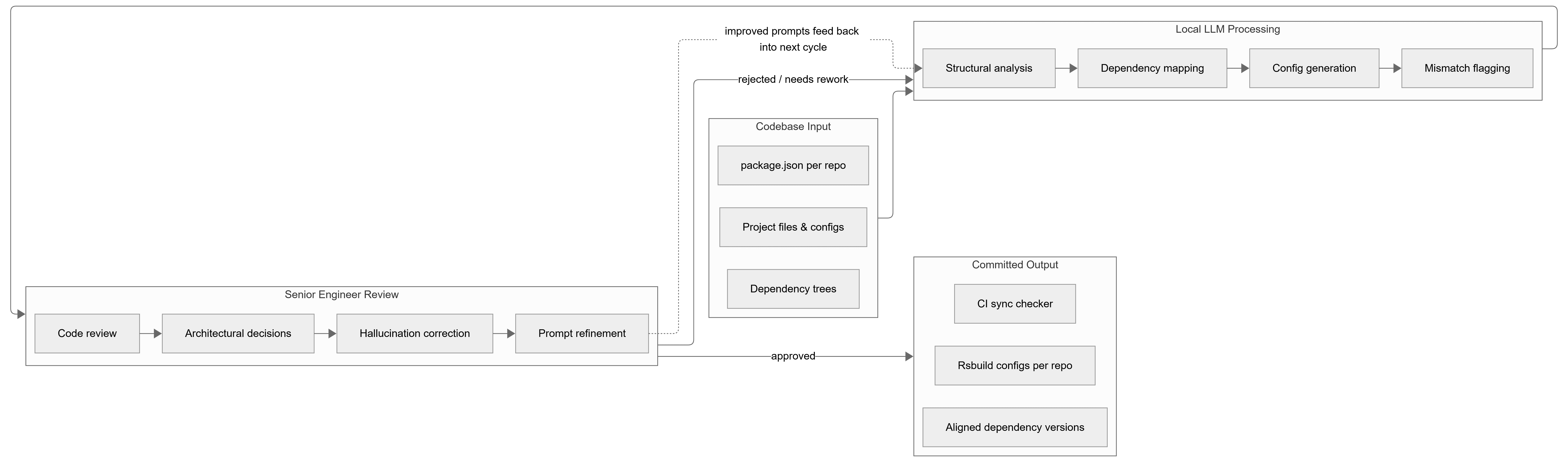
The migration followed a structured four-step process:
• Inventory & analysis: Project files, build configs, and dependency trees from each micro frontend were fed to the LLM for structural analysis. The AI mapped which libraries were shared, where version mismatches existed, and which configs needed rewriting.
• Config generation: The LLM generated new Rsbuild configurations for each repository, translating WebPackspecific patterns to their Rsbuild equivalents. Each output was reviewed and corrected by the engineer before committing.
• Dependency resolution: The AI identified shared libraries and flagged version discrepancies across all 6 repos. This work would normally require manually cross-referencing package.json files across multiple repositories.
• Validation & iteration: Every AI-generated output went through human review. Hallucinations were caught and corrected, prompts were refined, and the model’s understanding of the codebase improved with each cycle.
The Dependency Sync Checker
The migration itself exposed a deeper problem: there was no structural mechanism to prevent library version drift across micro frontends. So, the engineer built one.
Using the same local LLM infrastructure, they created a custom CI-time tool that scans library versions across all repositories and flags inconsistencies before they make it to runtime. This runs automatically on every build – existing tools (syncpack, manypkg) didn’t fit their cross-repo micro frontend topology, so they built one tuned to it. It catches the exact class of bug that had been plaguing the team: “this worked in isolation but breaks when assembled.”
Testing & Feature Parity
Ensuring nothing broke during the migration relied on a combination of approaches:
• Build-level validation: Each migrated micro frontend was compiled and tested against the shell app. Breakage in shared component rendering or routing was caught immediately at build time.
• Manual smoke testing: Core user flows per domain were walked through manually to verify functional parity.
• Honest risk acceptance: With only ~35% unit test coverage and no integration suite, the team acknowledged that full automated regression wasn’t possible. Writing a comprehensive test suite first would have added weeks. The pragmatic choice was to validate structurally (builds + CI tooling) and manually (critical flows), then catch edge cases in the cleanup phase.
Follow-Up Work
Post-migration cleanup took roughly 3 days:
• Days 1-2: Three shared libraries (UI component library, date formatting, API client) had minor version conflicts causing rendering edge cases - date picker locale handling and tooltip positioning in shared components.
• Day 3: Rsbuild’s dev server hot-reload handled dynamic imports slightly differently from WebPack. Two repos needed config adjustments to match production bundling behavior.
• Ongoing: The CI dependency sync checker now catches 2-3 version drift issues per month that would previously have gone undetected until a user hit a bug in production.
The core tools were Qwen 3 and GPT-OSS (~120B parameter models) running on the engineer’s personal laptop, accessed via a self-hosted OpenAI-compatible endpoint over local network. This wasn’t a cloud service or a SaaS subscription; it was a self-hosted model, iteratively trained for frontend engineering tasks through months of prompt-and-review cycles.
The migration followed a structured four-step process:
• Inventory & analysis: Project files, build configs, and dependency trees from each micro frontend were fed to the LLM for structural analysis. The AI mapped which libraries were shared, where version mismatches existed, and which configs needed rewriting.
• Config generation: The LLM generated new Rsbuild configurations for each repository, translating WebPackspecific patterns to their Rsbuild equivalents. Each output was reviewed and corrected by the engineer before committing.
• Dependency resolution: The AI identified shared libraries and flagged version discrepancies across all 6 repos. This work would normally require manually cross-referencing package.json files across multiple repositories.
• Validation & iteration: Every AI-generated output went through human review. Hallucinations were caught and corrected, prompts were refined, and the model’s understanding of the codebase improved with each cycle.
The Dependency Sync Checker
The migration itself exposed a deeper problem: there was no structural mechanism to prevent library version drift across micro frontends. So, the engineer built one.
Using the same local LLM infrastructure, they created a custom CI-time tool that scans library versions across all repositories and flags inconsistencies before they make it to runtime. This runs automatically on every build – existing tools (syncpack, manypkg) didn’t fit their cross-repo micro frontend topology, so they built one tuned to it. It catches the exact class of bug that had been plaguing the team: “this worked in isolation but breaks when assembled.”
Testing & Feature Parity
Ensuring nothing broke during the migration relied on a combination of approaches:
• Build-level validation: Each migrated micro frontend was compiled and tested against the shell app. Breakage in shared component rendering or routing was caught immediately at build time.
• Manual smoke testing: Core user flows per domain were walked through manually to verify functional parity.
• Honest risk acceptance: With only ~35% unit test coverage and no integration suite, the team acknowledged that full automated regression wasn’t possible. Writing a comprehensive test suite first would have added weeks. The pragmatic choice was to validate structurally (builds + CI tooling) and manually (critical flows), then catch edge cases in the cleanup phase.
Follow-Up Work
Post-migration cleanup took roughly 3 days:
• Days 1-2: Three shared libraries (UI component library, date formatting, API client) had minor version conflicts causing rendering edge cases - date picker locale handling and tooltip positioning in shared components.
• Day 3: Rsbuild’s dev server hot-reload handled dynamic imports slightly differently from WebPack. Two repos needed config adjustments to match production bundling behavior.
• Ongoing: The CI dependency sync checker now catches 2-3 version drift issues per month that would previously have gone undetected until a user hit a bug in production.
The core tools were Qwen 3 and GPT-OSS (~120B parameter models) running on the engineer’s personal laptop, accessed via a self-hosted OpenAI-compatible endpoint over local network. This wasn’t a cloud service or a SaaS subscription; it was a self-hosted model, iteratively trained for frontend engineering tasks through months of prompt-and-review cycles.
The migration followed a structured four-step process:
• Inventory & analysis: Project files, build configs, and dependency trees from each micro frontend were fed to the LLM for structural analysis. The AI mapped which libraries were shared, where version mismatches existed, and which configs needed rewriting.
• Config generation: The LLM generated new Rsbuild configurations for each repository, translating WebPackspecific patterns to their Rsbuild equivalents. Each output was reviewed and corrected by the engineer before committing.
• Dependency resolution: The AI identified shared libraries and flagged version discrepancies across all 6 repos. This work would normally require manually cross-referencing package.json files across multiple repositories.
• Validation & iteration: Every AI-generated output went through human review. Hallucinations were caught and corrected, prompts were refined, and the model’s understanding of the codebase improved with each cycle.
The Dependency Sync Checker
The migration itself exposed a deeper problem: there was no structural mechanism to prevent library version drift across micro frontends. So, the engineer built one.
Using the same local LLM infrastructure, they created a custom CI-time tool that scans library versions across all repositories and flags inconsistencies before they make it to runtime. This runs automatically on every build – existing tools (syncpack, manypkg) didn’t fit their cross-repo micro frontend topology, so they built one tuned to it. It catches the exact class of bug that had been plaguing the team: “this worked in isolation but breaks when assembled.”
Testing & Feature Parity
Ensuring nothing broke during the migration relied on a combination of approaches:
• Build-level validation: Each migrated micro frontend was compiled and tested against the shell app. Breakage in shared component rendering or routing was caught immediately at build time.
• Manual smoke testing: Core user flows per domain were walked through manually to verify functional parity.
• Honest risk acceptance: With only ~35% unit test coverage and no integration suite, the team acknowledged that full automated regression wasn’t possible. Writing a comprehensive test suite first would have added weeks. The pragmatic choice was to validate structurally (builds + CI tooling) and manually (critical flows), then catch edge cases in the cleanup phase.
Follow-Up Work
Post-migration cleanup took roughly 3 days:
• Days 1-2: Three shared libraries (UI component library, date formatting, API client) had minor version conflicts causing rendering edge cases - date picker locale handling and tooltip positioning in shared components.
• Day 3: Rsbuild’s dev server hot-reload handled dynamic imports slightly differently from WebPack. Two repos needed config adjustments to match production bundling behavior.
• Ongoing: The CI dependency sync checker now catches 2-3 version drift issues per month that would previously have gone undetected until a user hit a bug in production.
Results
Results
Results
The most immediate change was speed: a migration that would have consumed roughly a month of senior engineering time was completed in a week, with three days of cleanup. But the more significant change was structural.
Before the migration, the project frontend was held together by convention and manual discipline. Developers had to remember to sync library versions. Build configs were copy-pasted between repos with manual adjustments. Problems were discovered in production.
After the migration, the platform had:
• Modern build tooling (Rsbuild) with consistent configuration across all 6 repositories.
• Automated dependency monitoring that catches version drift at CI time, before code reaches production.
• A proven AI-augmented engineering workflow that the team could apply to subsequent challenges.
The migration was the first time AI was used for the team’s engineering work. Its success opened the door to a broader set of AI integrations, including autonomous code auditing, a RAG-based project knowledge service, and multi-agent bug fixing workflows.
Before vs. After Comparison
To validate the impact of our AI-augmented delivery frameworks, we benchmarked our AI-assisted migration architecture against traditional, purely manual engineering approaches.
Traditional approach | AI-assisted | |
|---|---|---|
Migration duration | ~4 weeks | ~1 week (+3 days cleanup) |
Engineers required | 1-2 senior frontend | 1 senior frontend |
Engineering hours | ~160 hrs | ~50 hrs |
Speed improvement | - | 3.5x faster |
Build configs rewritten | ~30 (manual) | ~30 (AI-generated, engineer-reviewed) |
Ongoing tooling | None | CI dependency checker (automated) |
Version drift detection | Runtime only (production bugs) | CI time (caught before deploy) |
The most immediate change was speed: a migration that would have consumed roughly a month of senior engineering time was completed in a week, with three days of cleanup. But the more significant change was structural.
Before the migration, the project frontend was held together by convention and manual discipline. Developers had to remember to sync library versions. Build configs were copy-pasted between repos with manual adjustments. Problems were discovered in production.
After the migration, the platform had:
• Modern build tooling (Rsbuild) with consistent configuration across all 6 repositories.
• Automated dependency monitoring that catches version drift at CI time, before code reaches production.
• A proven AI-augmented engineering workflow that the team could apply to subsequent challenges.
The migration was the first time AI was used for the team’s engineering work. Its success opened the door to a broader set of AI integrations, including autonomous code auditing, a RAG-based project knowledge service, and multi-agent bug fixing workflows.
Before vs. After Comparison
To validate the impact of our AI-augmented delivery frameworks, we benchmarked our AI-assisted migration architecture against traditional, purely manual engineering approaches.
Traditional approach | AI-assisted | |
|---|---|---|
Migration duration | ~4 weeks | ~1 week (+3 days cleanup) |
Engineers required | 1-2 senior frontend | 1 senior frontend |
Engineering hours | ~160 hrs | ~50 hrs |
Speed improvement | - | 3.5x faster |
Build configs rewritten | ~30 (manual) | ~30 (AI-generated, engineer-reviewed) |
Ongoing tooling | None | CI dependency checker (automated) |
Version drift detection | Runtime only (production bugs) | CI time (caught before deploy) |
The most immediate change was speed: a migration that would have consumed roughly a month of senior engineering time was completed in a week, with three days of cleanup. But the more significant change was structural.
Before the migration, the project frontend was held together by convention and manual discipline. Developers had to remember to sync library versions. Build configs were copy-pasted between repos with manual adjustments. Problems were discovered in production.
After the migration, the platform had:
• Modern build tooling (Rsbuild) with consistent configuration across all 6 repositories.
• Automated dependency monitoring that catches version drift at CI time, before code reaches production.
• A proven AI-augmented engineering workflow that the team could apply to subsequent challenges.
The migration was the first time AI was used for the team’s engineering work. Its success opened the door to a broader set of AI integrations, including autonomous code auditing, a RAG-based project knowledge service, and multi-agent bug fixing workflows.
Before vs. After Comparison
To validate the impact of our AI-augmented delivery frameworks, we benchmarked our AI-assisted migration architecture against traditional, purely manual engineering approaches.
Traditional approach | AI-assisted | |
|---|---|---|
Migration duration | ~4 weeks | ~1 week (+3 days cleanup) |
Engineers required | 1-2 senior frontend | 1 senior frontend |
Engineering hours | ~160 hrs | ~50 hrs |
Speed improvement | - | 3.5x faster |
Build configs rewritten | ~30 (manual) | ~30 (AI-generated, engineer-reviewed) |
Ongoing tooling | None | CI dependency checker (automated) |
Version drift detection | Runtime only (production bugs) | CI time (caught before deploy) |
Benefits
Benefits
Benefits
Direct time savings
Direct time savings
Direct time savings
~110 engineering hours saved on the migration alone. At typical senior frontend rates, that’s a meaningful cost reduction on a single project.
~110 engineering hours saved on the migration alone. At typical senior frontend rates, that’s a meaningful cost reduction on a single project.
~110 engineering hours saved on the migration alone. At typical senior frontend rates, that’s a meaningful cost reduction on a single project.
Ongoing cost avoidance
Ongoing cost avoidance
Ongoing cost avoidance
The dependency sync checker prevents ~2-3 production-impacting version drift bugs per month. Each one would typically take half a day to diagnose and fix – that’s roughly 12-18 engineering hours saved per month.
The dependency sync checker prevents ~2-3 production-impacting version drift bugs per month. Each one would typically take half a day to diagnose and fix – that’s roughly 12-18 engineering hours saved per month.
The dependency sync checker prevents ~2-3 production-impacting version drift bugs per month. Each one would typically take half a day to diagnose and fix – that’s roughly 12-18 engineering hours saved per month.
Infrastructure savings
Infrastructure savings
Infrastructure savings
Subsequent AI-assisted optimization work (caching, request throttling) reduced redundant API calls that were costing $6-7 per day in unnecessary database load.
Subsequent AI-assisted optimization work (caching, request throttling) reduced redundant API calls that were costing $6-7 per day in unnecessary database load.
Subsequent AI-assisted optimization work (caching, request throttling) reduced redundant API calls that were costing $6-7 per day in unnecessary database load.
Capacity multiplication
Capacity multiplication
Capacity multiplication
Following the migration, the same engineer was able to work across 6 projects in parallel, regularly closing 20 story points per week. A full management console (28 unique pages, 6 user roles) was built from scratch in ~3 weeks, work that would typically take 5-6 months.
Following the migration, the same engineer was able to work across 6 projects in parallel, regularly closing 20 story points per week. A full management console (28 unique pages, 6 user roles) was built from scratch in ~3 weeks, work that would typically take 5-6 months.
Conclusion
Conclusion
Conclusion
A common question from engineering leaders is whether AI should be part of their delivery model. The answer depends on how it is applied. AI doesn’t replace engineering judgment. It amplifies it. The migration succeeded not because an AI wrote the code, but because a senior engineer who understood the architecture used AI to eliminate the mechanical parts of the work: scanning configs, generating boilerplate, mapping dependencies, flagging inconsistencies.
The pattern is transferable. Whether you’re migrating from Angular to React, consolidating microservices, upgrading a build system, or untangling years of dependency debt, the approach is the same:
Start with a senior engineer who understands both the source and target architecture.
Use AI to automate the inventory, analysis, and generation work that’s time-consuming but not judgment intensive.
Keep the human in the loop for every architectural decision and every code review.
Build tooling (not just outputs) that continues to deliver value after the migration is done.
The dependency sync checker is the proof of this principle. It wasn’t part of the original scope. It emerged because the engineer, freed from mechanical work, had the capcity to solve the structural problem underneath the migration. That’s what AI-augmented engineering actually looks like: not faster typing, but more time to think.
A common question from engineering leaders is whether AI should be part of their delivery model. The answer depends on how it is applied. AI doesn’t replace engineering judgment. It amplifies it. The migration succeeded not because an AI wrote the code, but because a senior engineer who understood the architecture used AI to eliminate the mechanical parts of the work: scanning configs, generating boilerplate, mapping dependencies, flagging inconsistencies.
The pattern is transferable. Whether you’re migrating from Angular to React, consolidating microservices, upgrading a build system, or untangling years of dependency debt, the approach is the same:
Start with a senior engineer who understands both the source and target architecture.
Use AI to automate the inventory, analysis, and generation work that’s time-consuming but not judgment intensive.
Keep the human in the loop for every architectural decision and every code review.
Build tooling (not just outputs) that continues to deliver value after the migration is done.
The dependency sync checker is the proof of this principle. It wasn’t part of the original scope. It emerged because the engineer, freed from mechanical work, had the capcity to solve the structural problem underneath the migration. That’s what AI-augmented engineering actually looks like: not faster typing, but more time to think.
A common question from engineering leaders is whether AI should be part of their delivery model. The answer depends on how it is applied. AI doesn’t replace engineering judgment. It amplifies it. The migration succeeded not because an AI wrote the code, but because a senior engineer who understood the architecture used AI to eliminate the mechanical parts of the work: scanning configs, generating boilerplate, mapping dependencies, flagging inconsistencies.
The pattern is transferable. Whether you’re migrating from Angular to React, consolidating microservices, upgrading a build system, or untangling years of dependency debt, the approach is the same:
Start with a senior engineer who understands both the source and target architecture.
Use AI to automate the inventory, analysis, and generation work that’s time-consuming but not judgment intensive.
Keep the human in the loop for every architectural decision and every code review.
Build tooling (not just outputs) that continues to deliver value after the migration is done.
The dependency sync checker is the proof of this principle. It wasn’t part of the original scope. It emerged because the engineer, freed from mechanical work, had the capcity to solve the structural problem underneath the migration. That’s what AI-augmented engineering actually looks like: not faster typing, but more time to think.
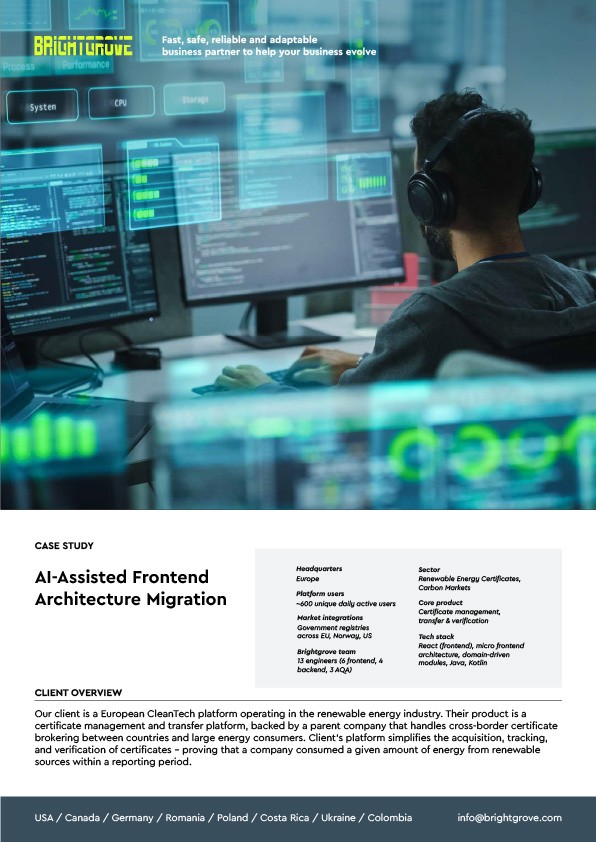
Download extended case study in .pdf
AI Development Services
Custom AI & Machine Learning solutions that transform complex operations, drive predictive insights, and maximize ROI from day one.
View the service page

Related content
Related content
Explore similar case studies by industry or service.
Explore similar case studies by industry or service.

Renewable Energy
Cloud
Microservices
7 minutes to read
Renewable Energy Cloud-Based Asset Management
Discover how Brightgrove builds cloud monitoring platforms for renewable energy operators: optimizing solar and wind plant performance with IoT telemetry.
Discover how Brightgrove builds cloud monitoring platforms for renewable energy operators: optimizing solar and wind plant performance with IoT telemetry.

Data Analytics
Cloud
REST API
8 minutes to read
Coginiti—Data Analytics Management Software
How Brightgrove partners with Coginiti to engineer enterprise data analytics tools: high-performance query execution, team SQL cataloging, and multi-cloud DBs.
How Brightgrove partners with Coginiti to engineer enterprise data analytics tools: high-performance query execution, team SQL cataloging, and multi-cloud DBs.

E-commerce
Salesforce
IoT
4 minutes to read
ZWILLING — scalable e-commerce & mobile architecture modernization
Brightgrove modernized ZWILLING's Salesforce Commerce Cloud platform and rebuilt native iOS/Android apps — enabling faster market rollouts and a 30+ FTE long-term partnership.
Brightgrove modernized ZWILLING's Salesforce Commerce Cloud platform and rebuilt native iOS/Android apps — enabling faster market rollouts and a 30+ FTE long-term partnership.
© 2026 Brightgrove. All rights reserved.
© 2026 Brightgrove. All rights reserved.
© 2026 Brightgrove. All rights reserved.
© 2026 Brightgrove. All rights reserved.